
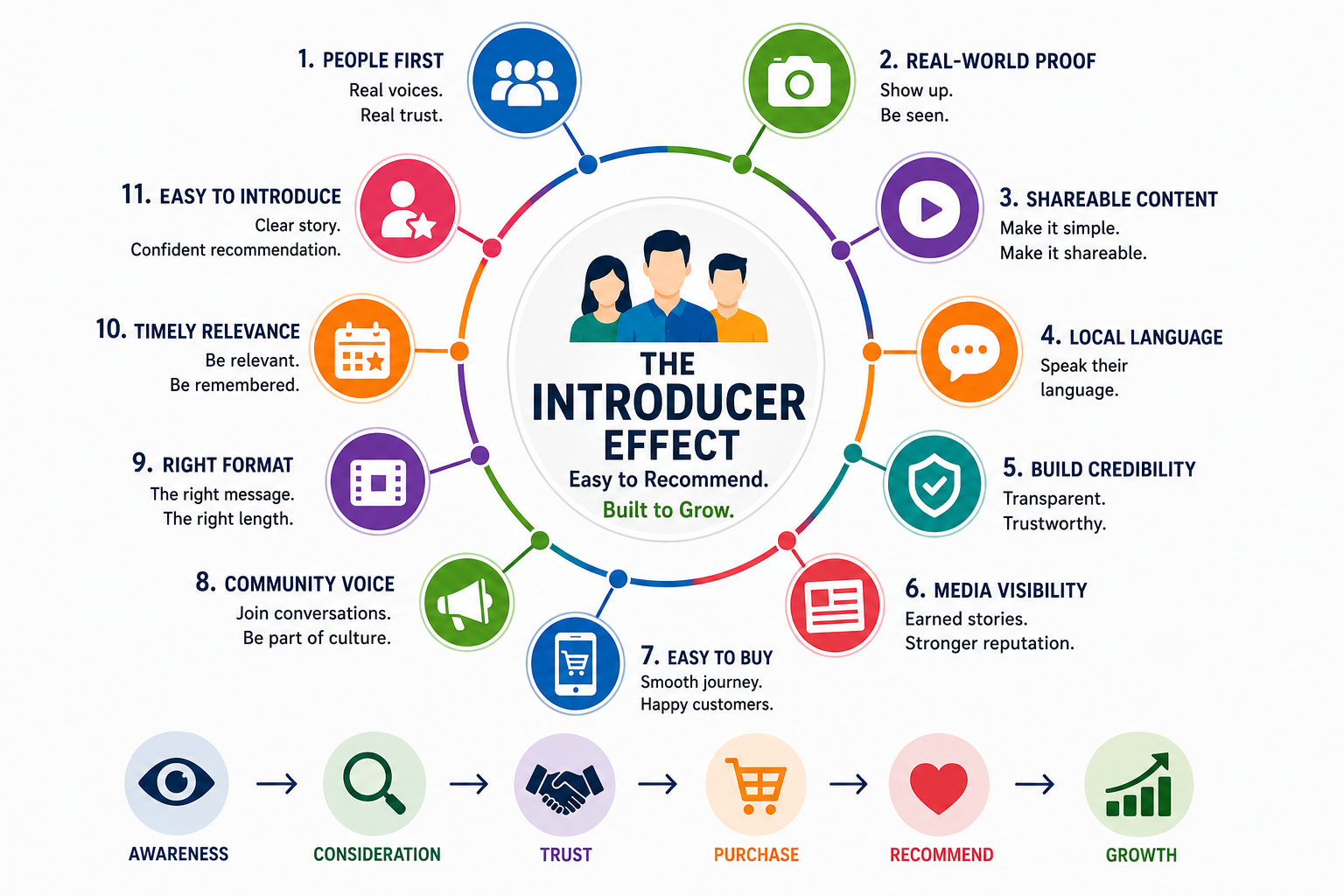
The most valuable customer is not always the person who buys first.
Often, it is the person who introduces the brand to someone else.
They tell a friend about a product they discovered. They share a useful video in a family WhatsApp group. They recommend a service to a colleague. They forward a founder interview to a business partner. They mention a new local brand to a retailer, distributor, neighbour or relative.
That moment of introduction can be more powerful than an advertisement.
Advertising creates awareness. Recommendation creates confidence.
A person may be willing to notice a brand through an ad, but they are more likely to consider it seriously when someone they trust says, “You should look at this.” That person may be a creator, customer, journalist, local retailer, doctor, industry expert, distributor, employee, family member or friend.
For Indian brands trying to grow across categories, cities and languages, the challenge is not only to become visible. It is to become easy to introduce.
The business needs a simple story. It needs proof that travels. It needs content that is easy to share. It needs local relevance. It needs credibility outside its own marketing channels. It needs a product experience that does not create friction when someone finally decides to explore or buy.
The strongest brands do not rely only on self-promotion.
They build a system that gives other people reasons to speak about them.
People Trust People Before They Trust Campaigns
Customers are becoming more selective about traditional advertising.
They know when a brand is paying for attention. They recognise scripted claims. They understand that every product will describe itself as better, smarter, healthier, faster or more premium.
But when a person they already follow, admire or trust speaks about a product, the message feels different.
This does not mean that every company needs a celebrity campaign.
In many cases, the strongest advocates are not famous at all. They may be niche creators, local professionals, category experts, community voices, loyal customers or micro-influencers who speak to a highly relevant audience.
A well-planned influencer PR strategy can help a business identify voices that fit the brand instead of simply chasing large follower counts.
The right person should already have credibility with the audience the company wants to reach. A food brand may need creators who are trusted for recipes and everyday recommendations. A skincare company may need people who communicate honestly about routines and product use. A B2B service may need industry voices who can explain why the offering matters. A healthcare or wellness brand may need responsible experts who can help people understand the category without making exaggerated promises.
The role of an influencer is not only to create reach.
It is to reduce the distance between the brand and the customer.
When the audience feels that the recommendation comes from someone who understands their needs, the company becomes easier to consider.
A Brand Needs Visual Evidence That It Is Active in the Real World
Many brands look convincing online but feel invisible in real life.
Their website may be polished. Their social-media pages may be active. Their advertisements may look professionally designed. But customers, distributors and partners may still wonder whether the company is truly present, growing and connected to real people.
This is where real-world proof becomes important.
A product launch, conference, partner event, customer gathering, retail activation, exhibition, award night or founder session can create a strong visual record of the brand in action.
Professional event photography helps preserve more than just memories from a gathering. It gives the business visual assets that can support press communication, social content, sales presentations, investor decks, partner outreach, internal communication and future campaigns.
The useful photographs are not only the stage shots.
They are the human moments.
The founder speaking with a customer. A distributor listening to a product demonstration. A team member explaining a new offering. A guest interacting with the product. A full room during an important announcement. A local partner standing beside the brand identity.
These images make the company feel more tangible.
They show that the business has customers, conversations, relationships and momentum beyond a digital campaign.
For a growing company, that type of proof becomes increasingly valuable because it gives future customers something to recognise before they have their own experience with the brand.
Recommendation Needs Content That Can Travel Fast
A customer may like a product, but if they cannot explain it easily, they may never recommend it.
This is why a brand needs content that makes sharing simple.
A ten-minute founder film may be useful for a website, but it may not be the format someone shares with a friend. A dense product brochure may help a sales team, but it may not be useful inside a WhatsApp conversation. A long technical explanation may impress an internal team but may not be easy for a retailer to show a new customer.
The strongest content systems create different levels of explanation.
There may be a short clip that introduces the product. A simple visual that shows the benefit. A customer story that makes the result relatable. A longer video that explains the process. A short city-level edit that helps a local campaign feel more relevant.
A regional video editing workflow for Kochi-based campaigns can help businesses turn raw footage, customer conversations, creator visits, product demonstrations and launch moments into content that works across different platforms.
The key is not to create content only for publishing.
The key is to create content that people can pass along.
A customer should be able to send it to a friend. A distributor should be able to share it with a retailer. A sales executive should be able to use it after a meeting. A founder should be able to include it in an investor discussion. A creator should be able to adapt it into something natural for their audience.
When content travels easily, trust travels with it.
Transparency Makes a Brand More Comfortable to Recommend
People hesitate to recommend businesses when they are unsure about the company behind them.
They may like the product, but they may not know whether the organisation is responsible, stable, transparent or serious about its long-term commitments.
This is especially important for brands connected to community work, sustainability, social impact, healthcare, education, rural development, ethical sourcing, public awareness or purpose-led business models.
Customers increasingly want to know what a brand is actually doing, not only what it says it believes.
A clear annual and impact-reporting approach can offer an important lesson for commercial brands as well.
The strongest reporting does not use vague language.
It helps people understand what happened, who was involved, what changed, where the resources went and what the organisation plans to improve next.
For a business, this kind of transparency may appear through sustainability updates, annual reports, supplier stories, community partnerships, customer outcomes, quality standards, employee initiatives or measurable local impact.
The goal is not to produce a document only because reporting is expected.
The goal is to give people evidence that the company is doing meaningful work with discipline and care.
A brand that can show proof becomes easier for customers, employees, investors and partners to recommend.
Language Builds Confidence Before the Customer Even Understands the Full Offer
A customer may understand English perfectly well and still respond more positively to a campaign that speaks naturally in their own language.
This is especially true when the purchase involves family discussion, local trust, education, health, property, finance, food, retail, consumer goods or services that need time and reassurance.
Language is not only about translation.
It is about comfort.
A business entering Punjab, Chandigarh, Ludhiana, Amritsar or Jalandhar needs more than a national campaign with a different voiceover. It needs to understand how people in the market speak, what they value, what kind of proof they expect and how they make decisions.
A focused TV9 Punjabi advertising approach can help brands think about Punjabi-language visibility through regional news, digital content, founder conversations, interviews, branded storytelling and local campaign formats.
The audience should feel that the message was created for them, not simply adapted for their location.
A family-oriented consumer brand may need warmth, familiarity and everyday use cases. An education company may need trust from parents and students. A local service may need clear city relevance. A real-estate brand may need credible information around neighbourhoods, access and long-term value.
When a company speaks in the language of the market, it becomes easier for people to introduce the brand to someone else.
Aspirational Audiences Need More Than a Product Claim
Some brands are bought because they solve a practical problem.
Others are chosen because they represent a lifestyle aspiration.
A premium food brand may represent discovery and taste. A home brand may represent better living. A beauty brand may represent self-care. A travel service may represent experience and freedom. A premium consumer product may represent achievement, design or confidence.
These categories need communication that feels more emotionally connected than a standard promotional advertisement.
A well-matched Zee Café advertising plan can help lifestyle, premium retail, travel, food, personal-care and aspirational brands explore an audience environment built around design, entertainment, culture and modern living.
The purpose is not simply to associate a product with a premium setting.
The purpose is to make the brand feel relevant to the way the customer wants to live.
People often recommend aspirational brands because the recommendation says something about their own taste, choices or identity. They may share a product because it looks good, feels interesting, solves a problem elegantly or helps them feel more informed.
A brand that understands this can create communication that is easier to talk about.
Long-Form Cultural Context Can Build Deeper Consideration
Not every customer will decide after seeing a quick video or short ad.
Some people want more context.
They may want to understand the founder, the product story, the cultural relevance, the category change or the larger idea behind the business. They may want to spend time with content that feels more considered and less rushed.
This is where deeper editorial-style environments can be valuable.
A thoughtful Desh advertising format can help businesses think about reaching audiences through longer-form cultural, literary and editorial contexts rather than relying only on fast-moving promotional media.
For a brand with a meaningful story, this can be powerful.
A heritage food company may want to discuss regional ingredients. A publisher may want to explain a new cultural initiative. A premium education brand may want to communicate its point of view. A design-led business may want to show how it thinks about craftsmanship, materials or local identity.
The strongest long-form communication does not feel like an oversized advertisement.
It gives the audience something worth reading, watching or discussing.
When a business contributes a useful perspective, it becomes easier for people to remember and recommend.
Complex Ideas Become More Shareable When They Become Visual
Some businesses struggle because their products are difficult to describe quickly.
The service may be technical. The product may have several stages. The value may sit inside a process that customers cannot see. The brand may be introducing a new category that requires explanation before the audience understands why it matters.
A complex product should not depend entirely on a salesperson to explain it.
It should have a visual story.
A well-built motion-graphics explainer can help turn an abstract idea, technical workflow, service process, product feature or customer journey into something people can understand in seconds.
A customer may not remember every technical detail, but they should remember the main benefit.
A distributor may not need to explain every internal mechanism, but they should be able to show a simple visual that makes the product feel credible. A potential investor may not need a long presentation if the company can show the scale of the opportunity clearly. A retailer may not need to study a full manual if the product use case is obvious.
When the business becomes easier to understand, it becomes easier to recommend.
Visual clarity gives people the confidence to introduce the brand without worrying that they will explain it incorrectly.
Media Coverage Gives the Brand Proof Outside Its Own Channels
Customers know that brands control their own advertisements.
They know that a company can choose its own photographs, write its own claims and decide which testimonials to publish. That does not mean self-promotion is not useful, but external visibility can create an additional layer of confidence.
A media mention, business story, interview, press release, feature or local publication can help a brand look more established because the business is being seen outside its own digital ecosystem.
A structured PR and media-coverage approach can help companies think about what is genuinely worth communicating.
The best stories are rarely “our company exists.”
They are about progress.
A new market entry. A useful product launch. A partnership. A local hiring initiative. A community programme. A business milestone. A research report. An expansion. A founder perspective. A new facility. A customer impact story.
The business should have something relevant to say.
When the story is useful and the communication is clear, media visibility becomes something that customers and partners can point to later.
That is an important part of the introducer effect.
People feel more comfortable recommending a company when they can see that the brand has public proof of movement and credibility.
Digital Communities Need an Honest, Conversational Voice
Hindi-speaking digital audiences are not one single group.
They include students, young professionals, family decision-makers, entrepreneurs, small-business owners, first-time buyers, mobile-first consumers, city shoppers and people who want content that feels natural rather than overly corporate.
A brand that wants to build relevance in Hindi markets needs more than direct translation.
It needs a voice that feels current, useful and culturally close to the audience.
A targeted The Lallantop advertising strategy can help businesses think about digital Hindi audiences who engage with news, explainers, culture, entertainment and conversational storytelling.
For certain categories, the best message is not a polished corporate film.
It may be a founder explaining a useful insight. A product story that feels relatable. A customer journey. A simple explainer. A city-specific offer. A practical video that answers a question customers already have.
The key is authenticity.
Digital communities respond strongly when they feel that a brand is trying to communicate with them instead of simply broadcasting at them.
When the audience feels included in the conversation, they are more likely to share the brand with others.
Some Stories Need More Than Ten Seconds
Short formats are useful for reminders, quick offers and simple product awareness.
But some brands need more room.
A healthcare service may need to explain what happens after a consultation. A financial company may need to reduce confusion around a process. A real-estate business may need to show location, family relevance and long-term value. An education brand may need to explain the outcome for students and parents. A premium product may need to create an emotional story before asking people to act.
For Maharashtra-based campaigns, a 40-second Marathi television spot can give a brand more room to communicate a useful narrative rather than forcing every idea into a short reminder format.
The purpose of a longer spot is not to add more words.
It is to create a better story.
The customer should understand the situation, see the problem, recognise the solution and feel that the brand belongs naturally in the story.
A well-told narrative can become easier to recommend because people remember it as more than an advertisement.
They remember it as something that made sense.
The Recommendation Journey Ends at the Purchase Moment
A customer may hear about a brand from a creator, see an event photograph, watch a product video, read a media story, encounter a regional campaign and become genuinely interested.
But the entire recommendation journey can fail if the product is difficult to buy.
For FMCG, food, personal-care, beauty, wellness, home and consumer brands, the final decision often happens on a small mobile screen.
The customer may open a quick-commerce app, search the category, compare thumbnails, check pricing, examine pack sizes and decide within seconds whether the product is worth trying.
A clear quick-commerce consulting strategy can help brands connect earlier marketing activity with the actual point of purchase.
The listing should make sense immediately.
The product image should be clear. The title should be easy to understand. The pack should be readable at a small size. The benefit should be visible. The price and bundle logic should be simple. The product should be available where the customer expects it.
The customer does not separate word of mouth from availability.
They only know whether the recommendation was easy to act on.
A strong brand experience makes the final step feel natural.
Final Thoughts
The most powerful brand introductions often happen when the company is not in the room.
A customer tells a friend. A creator shares a product. A retailer recommends a new option. A distributor sends a video. A family member forwards an article. A local partner points someone toward the business. A journalist covers a meaningful milestone. A customer sees proof that the brand is active, clear and credible.
The companies that benefit most from these moments are not always the loudest.
They are the ones that make recommendation easy.
They have a simple story. They have visible proof. They create useful content. They respect regional language and context. They build credibility through real progress. They explain complex ideas clearly. They stay honest in digital communities. They give stories enough space when customers need more reassurance. And they make buying easy when interest finally turns into action.
That is how a business moves from being noticed to being introduced.
And when other people begin introducing the brand for you, growth becomes much easier to sustain.
Leave A Comment